Your shopping cart is empty!

Introduction
In Traditional Chinese Medicine (TCM), the concept of Liver Yang Rising represents a fundamental pathological pattern that illuminates the sophisticated TCM understanding of physiological balance, energy dynamics, and mind-body integration. This condition exemplifies how TCM perceives health not merely as the absence of disease, but as a harmonious equilibrium between complementary forces within the body. Liver Yang Rising offers a window into the holistic framework of Chinese medicine, where physical symptoms, emotional states, and environmental influences intertwine in a coherent diagnostic tapestry.
Theoretical Foundations: Yin-Yang Dynamics and the Liver's Role
To comprehend Liver Yang Rising, one must first appreciate the foundational principles of Yin and Yang—the complementary, interdependent forces that maintain all physiological processes. Yin represents the substantial, cooling, nourishing, and grounding aspects, while Yang embodies the active, warming, transforming, and ascending qualities. Health manifests when these forces maintain dynamic equilibrium.
Within this framework, the Liver organ system holds unique importance. The Liver governs the smooth flow of Qi (vital energy) throughout the body, regulates emotional equilibrium, stores blood, controls tendons, and manifests in the nails. Its energetic nature is inherently Yang, with a tendency to ascend and expand, yet it is tempered by Liver Yin, which provides cooling, moistening, and anchoring effects.
The Liver also maintains a special relationship with the Wood element in Five Phase theory, associating it with springtime, growth, movement, and the direction of upward/outward expansion. This elemental correspondence further explains the Liver's propensity for Yang rising when imbalanced.
Pathology of Liver Yang Rising
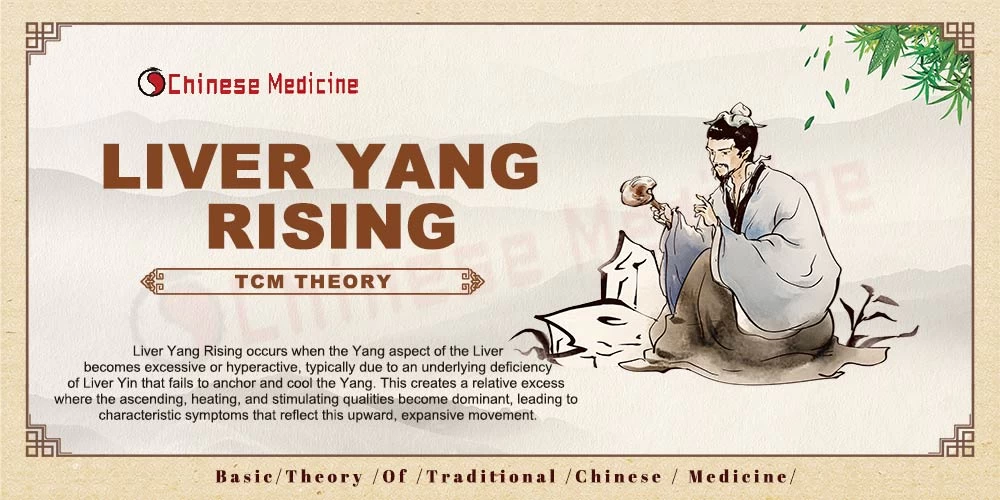
Liver Yang Rising occurs when the Yang aspect of the Liver becomes excessive or hyperactive, typically due to an underlying deficiency of Liver Yin that fails to anchor and cool the Yang. This creates a relative excess where the ascending, heating, and stimulating qualities become dominant, leading to characteristic symptoms that reflect this upward, expansive movement.
Primary Etiological Factors:
- Emotional Strain: Chronic anger, frustration, resentment, or repressed emotions directly affect the Liver's Qi-flowing function, potentially generating internal heat that consumes Yin over time.
- Dietary Influences: Excessive consumption of heating foods (spices, alcohol, greasy foods) or stimulants (coffee, certain medications) can generate internal heat that damages Yin.
- Constitutional Factors: Some individuals possess constitutional Yin deficiency or Yang excess tendencies that predispose them to this pattern.
- Aging Process: Yin naturally declines with age, potentially creating Yin-Yang imbalance.
- Chronic Illness: Prolonged conditions, especially those involving fever or heat patterns, can consume Yin fluids.
- Overwork and Insufficient Rest: Inadequate sleep, particularly night-time work, interferes with the Blood-returning-to-Liver process that nourishes Yin.
- Essence Depletion: Excessive sexual activity, chronic stress, or severe illness may deplete Kidney essence, which fails to nourish Liver Yin (via the Mother-Son relationship in Five Phase theory).
Clinical Manifestations
The symptoms of Liver Yang Rising vividly illustrate the ascending nature of the pathological process:
Physical Symptoms:
- Headache: Typically occipital, temporal, or vertex location with distending, throbbing quality
- Dizziness/Vertigo: Sensation of upward movement or spinning
- Tinnitus: High-pitched ringing resembling cicadas or whistling
- Visual Disturbances: Blurred vision, dry eyes, photophobia
- Facial Flushing: Particularly in cheek areas
- Hypertension: Frequently observed in Western medical correlation
- Dry Thirst: Without strong desire to drink
- Insomnia: Restless sleep with vivid dreams
- Muscle Twitching/Tremors: Especially in limbs
Emotional/Cognitive Symptoms:
- Irritability: Short temper, easily provoked to anger
- Impatience: Frustration with delays or obstacles
- Mental Restlessness: Difficulty calming thoughts
- Tension: Feeling "wound up" or unable to relax
Tongue and Pulse Diagnosis:
Tongue: Red tongue body, possibly with redder sides; dry coating; trembling
Pulse: Wiry (like a guitar string), rapid, and strong, particularly at the Liver position
The Kidney-Liver Axis: A Crucial Relationship
In TCM physiology, the Liver and Kidney share a profound connection—they share common origins (both derive from the Mingmen fire) and have a mutual nourishment relationship. Kidney Yin (the foundation of all Yin fluids) nourishes Liver Yin, while Liver Blood supplements Kidney essence. When Kidney Yin becomes deficient, it fails to nourish Liver Yin, leading to the rising of Liver Yang. This explains why Liver Yang Rising often incorporates elements of Kidney Yin deficiency, particularly in chronic cases.
Treatment Principles and Modalities
Herbal Treatment Strategies:
The primary treatment principle is to "subdue Liver Yang" and "nourish Liver and Kidney Yin." Classical formulas include:
TianMa GouTeng keli: Gastrodia and Uncaria Decoction
Specifically subdues Liver Yang while clearing heat
Contains herbs that anchor Yang downward and calm spirit
Zhen Gan Xi Feng Tang: Liver-Sedating and Wind-Extinguishing Decoction
For more severe cases with potential for internal wind
Stronger anchoring action with mineral substances
Qi Ju Di Huang Wan: Lycium, Chrysanthemum, and Rehmannia Pill
For cases with prominent Yin deficiency
Focuses on nourishing Yin while clearing deficient heat
Dietary Therapy:
- Increase Yin-nourishing foods: Black sesame, walnuts, eggs, dairy, seaweed, bone broth
- Cooling foods: Cucumber, watermelon, celery, mung beans
- Avoid heating foods: Spices, alcohol, coffee, excessive red meat
- Lifestyle and Emotional Regulation:
- Qigong/Tai Chi: Gentle movements that regulate Qi without overheating
- Meditation: Calms the Shen (spirit) and reduces Yang agitation
- Adequate Rest: Especially important during Yin-nourishing night hours
- Emotional Expression: Finding healthy outlets for frustration
Modern Research and Correlations
Contemporary research has explored TCM patterns through biomedical lenses. Liver Yang Rising shows correlations with:
Hypertension: Numerous studies demonstrate the efficacy of TCM approaches for essential hypertension
Migraine and Tension Headaches: The pattern frequently corresponds to vascular headaches
Menopausal Syndrome: Hot flashes, irritability, and insomnia often reflect Yin deficiency with Yang rising
Anxiety Disorders: The emotional components parallel certain anxiety manifestations
Neuroendocrine studies suggest that the Liver Yang Rising pattern may involve dysfunction in the hypothalamic-pituitary-adrenal axis and autonomic nervous system regulation. Imaging studies show that acupuncture points used for Liver Yang Rising modulate activity in brain regions involved in pain processing and emotional regulation.
Prevention and Long-Term Management
Given the chronic, recurring nature of Liver Yang Rising, prevention and maintenance strategies are crucial:
Seasonal Awareness: Spring (Liver season) requires particular attention to diet and emotional balance
Daily Rhythms: Aligning activity with natural Yang-Yin cycles (active by day, rest by night)
Constitutional Awareness: Individuals with Wood element constitution require specific lifestyle adaptations
Early Intervention: Recognizing and addressing early signs of Yin deficiency
Holistic Integration: Combining TCM with appropriate Western approaches when needed
Case Example
A 52-year-old male presented with recurrent temporal headaches, dizziness upon standing, tinnitus, irritability, and elevated blood pressure (150/95 mmHg). His tongue was red with scant coating, and his pulse was wiry and rapid. He worked long hours in a high-stress position and consumed multiple cups of coffee daily. Diagnosis: Liver Yang Rising with underlying Liver and Kidney Yin deficiency. Treatment included modified Tian Ma Gou Teng Yin herbs, acupuncture twice weekly (LV3, GB20, KI3, SP6), dietary modifications, and stress-reduction techniques. After six weeks, headache frequency reduced by 70%, blood pressure normalized to 135/85 mmHg, and sleep quality significantly improved.
Conclusion
Liver Yang Rising exemplifies the depth and clinical relevance of Traditional Chinese Medicine pathology. It demonstrates how TCM identifies patterns of imbalance that encompass physical symptoms, emotional states, and constitutional tendencies into a coherent diagnostic picture. Rather than simply treating symptoms, TCM addresses the root imbalances—in this case, the Yin deficiency that fails to anchor Yang—while managing the branch manifestations.
This pattern also illustrates the preventive wisdom inherent in Chinese medicine, emphasizing lifestyle harmonization with natural cycles and early intervention before full pathology develops. As integrative medicine evolves, patterns like Liver Yang Rising offer valuable perspectives on conditions that often prove challenging in conventional settings, particularly those involving mind-body interactions and chronic imbalance states.
The enduring relevance of this centuries-old pattern in modern clinical practice speaks to the profound observational wisdom embedded in TCM theory—a system that continues to offer unique insights into human health, disease, and the delicate balance between stability and transformation within the human organism.
-

- Date Published: 2025-11-29
- Category: Theory
Related Products
$16.00